


Opportunity
Vancomycin is one of the most widely used inpatient antibiotics for serious bacterial infections, yet its narrow therapeutic index makes consistent, safe dosing a persistent clinical challenge.
Across CHRISTUS Health's facilities, dosing practices varied significantly — some sites relied entirely on trough-based monitoring, while others used a mix of methods. Without a standardized, model-informed approach, patients remained at elevated risk for vancomycin-induced acute kidney injury (AKI), prolonged hospital stays, and avoidable costs. CHRISTUS set out to change that.
Solution
CHRISTUS Health partnered with InsightRX to implement InsightRX Nova across all facilities, integrated directly with Epic through a central pharmacy workflow. A prospective pre/post study was conducted to evaluate the impact of the intervention: during the pre-implementation period, patients were registered in InsightRX via the Epic integration while bedside pharmacists continued standard dosing workflows at each site. Following training, select pharmacists began using the Epic-integrated Nova module to apply Bayesian model-informed precision dosing (MIPD) for vancomycin, moving away from trough-based and manual methods toward individualized, AUC-guided therapy across all sites.
Impact
The results were striking. Across all sites, the AKI event rate occurring 48 or more hours into vancomycin therapy fell from 14.0% pre-implementation to 4.3% post-implementation, a roughly 70% relative reduction. After adjusting for patient-level factors, patients in the post-implementation cohort had approximately 57% lower odds of developing AKI (adjusted OR 0.43; p=0.01).
Historical benchmarking (scaled figures via bed size) indicates that that CHRISTUS could dose roughly 23,982 patients with vancomycin annually. Therefore, the network could prevent as many as 2,346 AKI events per year, and stands to save approximately $4.2M in direct AKI-related costs, based on a published per-event cost estimate of $1,795 (Silver et al, 2017).
Each prevented AKI event also reduces length of stay by an estimated 1.1 adjusted days (Silver et al, 2017), translating to 2,580 fewer bed-days annually and an additional $3.9M in saved inpatient expenses. Combined, the projected annualized financial impact is approximately $8.1M.
Results
Bayesian MIPD drove a 70% reduction in AKI event rates across all sites
Vancomycin-induced AKI was assessed using KDIGO criteria, counting events that occurred 48 or more hours into therapy. Pre-implementation, 14.0% of evaluable patients developed AKI at this threshold. Post-implementation, that figure dropped to 4.3%, a difference that held up after multivariable adjustment and was statistically significant (OR 0.43; p=0.01).
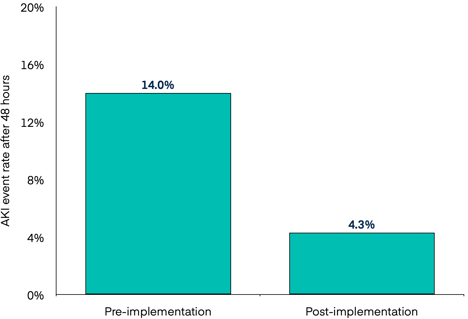
Figure 1 shows AKI event rates after 48 hours of therapy for pre- and post-InsightRX implementation groups. Similar results were shown when further broken apart by pre-implementation methodology (trough-based and mixed-methods).
After implementation of a standardized AUC dosing protocol alongside InsightRX, patients saw a 57% lower risk for acute kidney injury
To account for differences in patient characteristics between the pre- and post-implementation groups, a multivariable logistic regression was performed adjusting for age, sex, weight, BMI, days of therapy, loading dose use, and baseline creatinine. The adjusted analysis confirmed that the reduction in AKI risk was attributable to the intervention itself rather than underlying differences in patient population, with post-implementation patients showing 57% lower odds of developing AKI (OR 0.43; p=0.01).
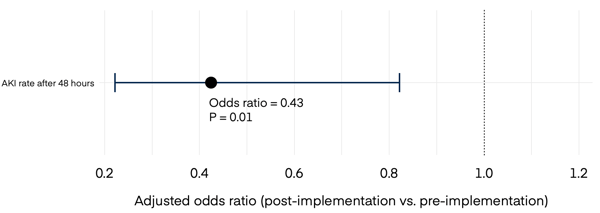
Figure 2 shows AKI event odds ratio for pre- and post-implementation groups. Significantly lower AKI rates (p=0.01) were seen after InsightRX implementation across all sites, along with the change to consistent AUC-based dosing.
AKI reductions were consistent across sites regardless of prior dosing method
Similar reductions were seen across both previously trough-based and previously mixed-method sites (sites with inconsistent AUC-based and trough-based dosing practices), demonstrating that the benefit of MIPD extends across different baseline dosing practices.
When broken out by baseline dosing methodology, sites previously using trough-based monitoring saw AKI event rates fall from 11.7% to 3.4% post-implementation, while sites using mixed-methods saw a reduction from 15.2% to 4.9%. The consistency of improvement across both groups strengthens the generalizability of the findings and supports system-wide adoption regardless of prior dosing practice.
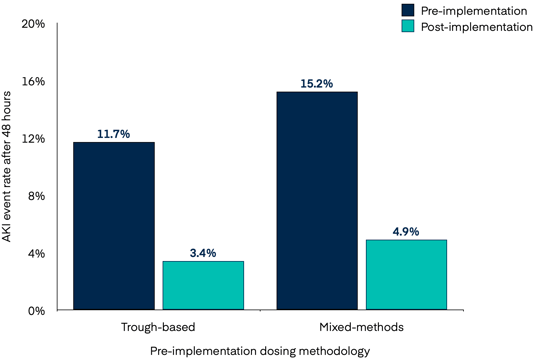
Figure 3 shows AKI event rates after 48 hours pre- and post-implementation of InsightRX, grouped by prior dosing methodology.
Conclusion
Across a diverse, multi-facility health system with varying baseline dosing practices, implementing InsightRX Nova alongside a standardized AUC dosing practice delivered meaningful reductions in vancomycin-induced kidney injury and generated substantial projected cost savings. The consistency of results across site types strengthens the case that Bayesian MIPD is effective not just in controlled settings, but at scale, and that precision dosing can become a genuine system-wide standard rather than a single-site initiative.