


Opportunity
Achieving optimal vancomycin exposure early in therapy is critical for patient outcomes, but many institutions struggle with suboptimal target attainment in the first 24-48 hours of treatment.
Cape Cod Healthcare faced this challenge despite using model-informed precision dosing. Only 16.6% of general adult patients achieved therapeutic AUC (400-600 mg·h/L) within the first 24 hours, while 38.6% experienced subtherapeutic exposures below 300 mg·h/L. The obese patient population showed similar challenges, with just 29.7% reaching therapeutic targets early and 25.3% experiencing subtherapeutic exposures (which can be particularly problematic for patients with serious infections requiring rapid therapeutic drug exposure levels).
Solution
InsightRX's Continuous Learning framework addresses this exact challenge through ongoing analysis of real-world dosing data to refine and optimize pharmacokinetic models. In August 2023, InsightRX announced updates to vancomycin PK models based on extensive analyses showing higher performance metrics and increased likelihood of reaching therapeutic targets.
Data was available that informed a more suitable model selection for Cape Cod: the modified Thomson was recommended for the general adult population, while the Hughes model was recommended for the obese adult population, which was specifically designed to address the tendency of previous models to overestimate exposure (and therefore lead to underdosing) in this patient group.
Cape Cod Healthcare implemented these updated PK models shortly after the announcement. The transition required no changes to workflows, training, or care processes. To evaluate impact, the clinical team analyzed data from 438 patients before the model switch (May 30 - Aug 30, 2023) and 430 patients after (Aug 30 - Nov 30, 2023).
Impact
The results were remarkable. Cape Cod Healthcare saw dramatic improvements in early target attainment across both patient populations, with the most significant gains occurring in the first 24-48 hours of therapy.
For the general adult population, early target attainment more than doubled from 16.6% to 39.3%. The obese adult population achieved even greater gains, with early target attainment increasing from 29.7% to 65.3%. Subtherapeutic exposures also dropped substantially in both populations. Importantly, AKI rates remained unchanged, confirming that improved target attainment did not compromise patient safety.
Results
Updated models more than doubled early target attainment in general adult population
Implementation of the modified Thomson model led to dramatic improvements in early therapy for the general adult population. Target attainment (AUC 400-600 mg·h/L) within the first 24 hours increased from 16.6% to 39.3% — a 136% relative improvement over baseline. The improvement was driven primarily by a 65% reduction in subtherapeutic exposures below 300 mg·h/L (38.6% to 13.6%), successfully addressing underdosing in early therapy.
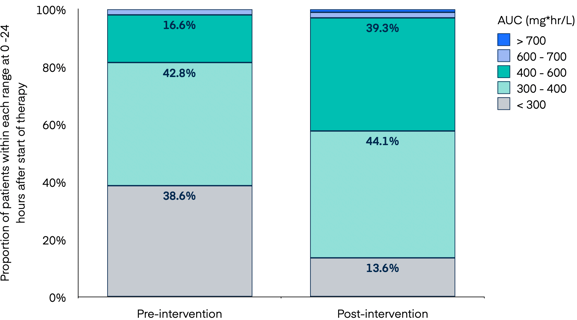
Figure 1 shows target attainment within the first 0-24 hours of therapy between pre- and post-intervention groups.
Obese population achieved 65% target attainment with updated Hughes model
The obese adult population also achieved remarkable gains with the updated Hughes obese patient model. Early target attainment within the first 24 hours increased from 29.7% to 65.3% (a 120% relative improvement), bringing nearly two-thirds of obese patients into therapeutic range from the start. The updated model completely eliminated supratherapeutic exposures above 700 mg·h/L during the first 48 hours, demonstrating improved precision. Subtherapeutic exposures decreased from 25.3% to 9.2% in the first 24 hours.
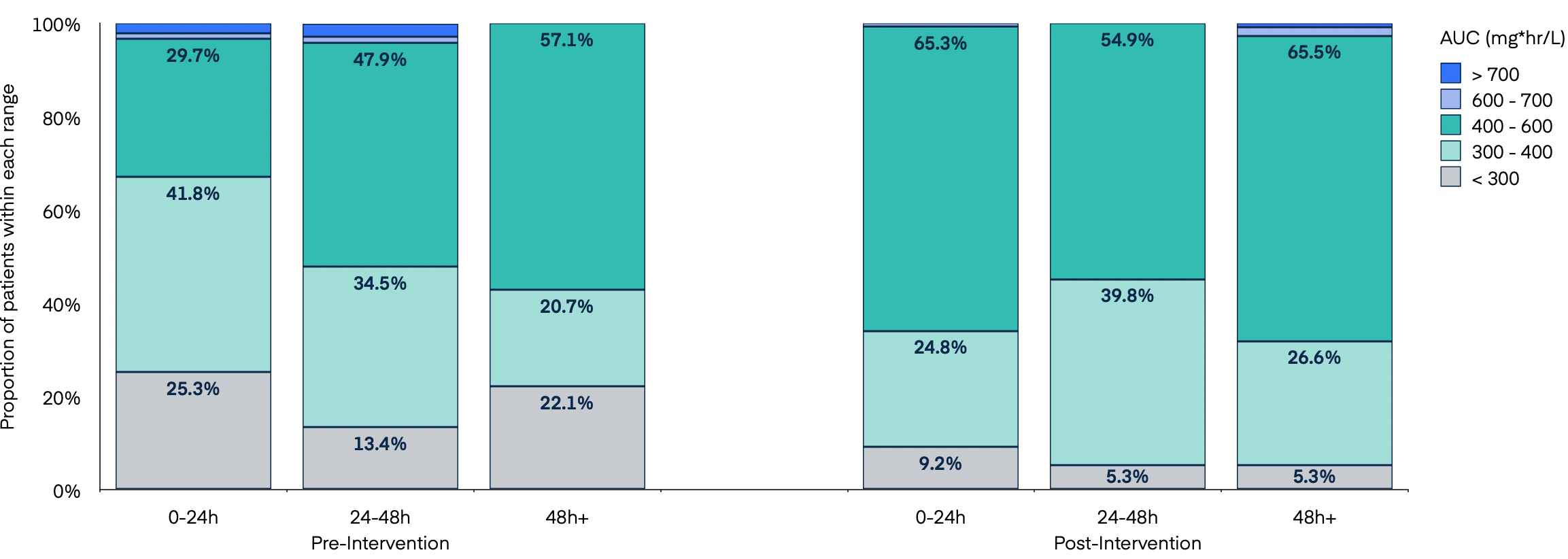
Figure 2 shows target attainment within between pre- and post-intervention groups for obese patients, using an improved PKPD model for that patient population.
Continuous Learning enabled optimization without workflow disruption
These improvements required no changes to clinical workflows, staff training, or care processes. The InsightRX Continuous Learning framework enabled Cape Cod Healthcare to benefit from insights derived from real-world data across multiple healthcare systems, with model updates deployed seamlessly. Pharmacists continued standard dosing practices while automatically leveraging more accurate predictions. The three-month timeline from model announcement to measurable improvement demonstrates how rapidly evidence-based updates can translate into better patient care.
Conclusion
Cape Cod Healthcare's experience demonstrates the power of Continuous Learning. By continuously analyzing real-world data and updating models based on evidence, InsightRX enables ongoing optimization without the burden of workflow redesign.
The dramatic improvements in early target attainment — more than doubling in the general population and achieving 65% in the obese population — show how data-driven model refinement addresses persistent clinical challenges. As the Continuous Learning process continues to refine models, healthcare systems using InsightRX can expect ongoing enhancements that translate directly into better patient outcomes.