


Opportunity
It can be challenging to assess how adoption of AUC-based dosing, and the many decisions that accompany it, is impacting patients in real time. Even with precision dosing tools in place, understanding whether dosing practices are optimized (and identifying opportunities for improvement) requires visibility into performance data and trends.
Huggins Hospital, a small community hospital in Wolfeboro, New Hampshire, implemented InsightRX Nova's adult vancomycin module in 2022 for precision dosing at the bedside. By mid-2024, their clinical pharmacists recognized the need to evaluate their dosing performance and determine whether their current practices were achieving optimal outcomes. Without clear visibility into their exposure data and target attainment trends, it was difficult to identify specific areas for improvement or measure the impact of practice changes.
InsightRX’s Nova and Apollo programs have helped drive a consistent clinical approach for patient care between pharmacists as well as identify opportunities for system process improvements, education, and new clinical tools for our physician team.
Solution
The pharmacy leadership team at Huggins Hospital leveraged InsightRX Apollo, an analytics platform designed to help clinical teams evaluate and refine their dosing practices. Apollo provided the visibility needed to review their vancomycin AUC exposure data across their patient population, revealing opportunities to improve early target attainment and reduce supratherapeutic exposures. The platform's actionable insights enabled the team to identify patterns in their dosing decisions and understand where adjustments could meaningfully impact patient outcomes.
Following their review of Apollo data, the pharmacy leadership team led a collaborative initiative to harmonize their vancomycin dosing strategy. This effort focused on leveraging Nova's modeling guidance, enhancing pharmacist education, and ensuring consistent attention to daily AUC exposures and dose selection. The team used Apollo's ongoing analytics to track their progress and validate that their practice changes were translating into improved outcomes.
Impact
By the first half of 2025, the impact of Huggins Hospital's data-driven approach was clear. The hospital saw a dramatic decrease in supra-therapeutic AUCs and a significant increase in patients achieving therapeutic levels at 48+ hours of therapy. Target attainment in the therapeutic range (AUC 400-600 mg*h/L) improved from 39% to 65% — a 67% relative increase.
Supra-therapeutic exposures above 700 mg*h/L were completely eliminated, dropping from 13% to 0%. Notably, there were zero acute kidney injury (AKI) events after 48 hours of therapy during both measurement periods, indicating that patient safety was maintained. These improvements demonstrate how data-driven collaboration and a unified clinical approach, enabled by analytics visibility, can lead to tangible patient care benefits.
Results
Data-driven optimization eliminated supra-therapeutic exposures and maintained safety
One of the key opportunities identified through Apollo analytics was the 13% of patients experiencing supra-therapeutic AUC levels above 700 mg*h/L during the baseline period, which correlate to exposures associated with increased risk of nephrotoxicity in vancomycin patients.1
The team's focused attention to daily AUC monitoring and dose adjustments, informed at the department level by InsightRX Apollo data, completely eliminated these high exposures in the post-intervention period. Importantly, the reduction in supra-therapeutic dosing was achieved without compromising safety: the institution maintained zero AKI events after 48 hours of therapy in both measurement periods, indicating that precision improvements sustained the already strong safety outcomes.
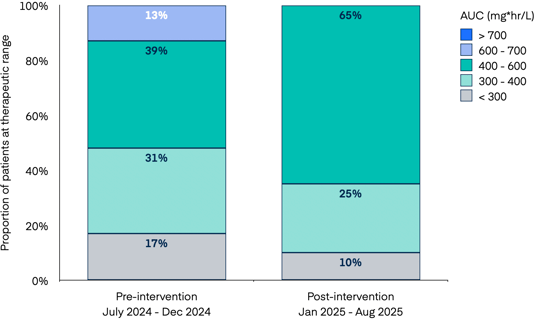
Figure 1 shows the proportion of patients in various AUC ranges after 48 hours of therapy for the pre- and post-intervention periods.
Using Apollo analytics to guide practice led to a 67% relative increase in target attainment
Apollo's visibility into exposure data enabled Huggins Hospital pharmacists to identify that only 39% of patients were achieving therapeutic AUC levels (400-600 mg·h/L) at 48+ hours during the baseline period (July to December 2024). Following the focused initiative to harmonize dosing practices, guided by insights from Apollo data review, target attainment increased to 65% in the first eight months of 2025. This 67% relative improvement represents a substantial gain in therapeutic precision, with nearly two-thirds of patients now achieving optimal exposure levels.
Apollo's continuous analytics enabled real-time tracking of practice improvement
Beyond identifying initial opportunities, Apollo’s ongoing analytics capabilities allowed the Huggins Hospital team to monitor the impact of their practice changes in real time. This continuous feedback loop enabled pharmacists to validate that their enhanced focus on dose selection and daily AUC monitoring was translating into measurable outcomes.
The pharmacists’ proactive clinical engagement, supported by the InsightRX clinical team’s guidance in optimizing access and usability, was instrumental in translating data insights into sustained practice improvements. Additionally, the ability to track performance trends over time in InsightRX Apollo provided the visibility needed to sustain improvements and ensure that gains in target attainment were maintained throughout the eight-month post-intervention period.
Conclusion
Huggins Hospital's success demonstrates that precision dosing tools are most effective when paired with analytics that provide visibility into performance and guide practice optimization.
By leveraging InsightRX Apollo to review their dosing data, identify opportunities, and track improvements, the pharmacy team achieved remarkable gains in target attainment while eliminating supra-therapeutic exposures — all while maintaining perfect safety outcomes.
These improvements underscore how small, focused adjustments in workflow, driven by data visibility and team collaboration, can meaningfully impact patient outcomes. The combination of Nova for precision dosing at the bedside and Apollo for performance analytics created a complete solution that enabled Huggins Hospital to not just monitor, but truly optimize therapy for their patients.